James Madison University announce
d on Monday, October 12, 2026, that i
t will be joining the American Conference and departing the Sun Belt Conference. Below are responses to frequently asked questions, as the Dukes prepare for transition into a new conference.
Frequently Asked Questions
Which schools are in the American Conference?
The American Conference "full" membership includes: Alabama-Birmingham, Charlotte, East Carolina, Florida Atlantic, Memphis, North Texas, Rice, South Florida, Temple, Texas-San Antonio, Tulane, Tulsa and Wichita State. In football, the conference also includes Army and Navy, while Wichita State does not sponsor football.
The American has multiple affiliate sport arrangements with different institutions, which includes JMU in women's lacrosse and swimming and diving. Other affiliate members include Missouri State in men's soccer, Liberty and Marshall in swimming and diving, as well as Vanderbilt and Old Dominion in lacrosse.
Are any other institutions joining the American with James Madison?
The current announcement involves only JMU and the American Conference.
Will all sports compete in the American Conference?
Once JMU officially joins the American, 17 of 18 James Madison sports will compete in the league. Field hockey will remain in the Mid-American Conference (MAC), as the American does not sponsor the sport.
When will JMU officially join the American Conference?
JMU will join the American no later than July 1, 2028.
Will JMU have to pay an exit fee to the Sun Belt and entrance fee to the American?
Yes, JMU will have to cover both a Sun Belt exit fee and American entry fee. However, the exit fee is being covered by new private funding from generous supporters, while the entry fee has already been committed from new private corporate partners who championed this move. Athletics and the university worked collaboratively with these individuals and partners in ensuring a financial model to meet this opportunity. As a result, the university did not have to fund any entry or exit costs internally. The university is committed to soliciting further support to ensure the competitive success of the move to the American.
Was JMU actively seeking new conference membership, or did the American approach JMU?
JMU was not proactively trying to leave the Sun Belt. Now in the fifth year of Sun Belt membership, James Madison has flourished in the league with the institution and the conference elevating each other. JMU has routinely stated that it works constantly to best position its athletics program for current and future success. On a day-to-day basis, that plays out in hiring and retaining the best coaches and staff; recruiting, retaining and developing high-level student-athletes; and deploying resources across all sport programs to foster success. Behind the scenes, the athletics and university administration always evaluate the conference and national landscape to ensure that the university is best positioned to maximize achievement in line with resources and to project future opportunities. The new arrangement between JMU and the American involves a mutual recognition of a good fit between the institution and the conference.
Why is this the right decision for James Madison University to join the American?
JMU strongly believes this is the right decision to join the American based on the following:
- Allows the university to align its ambition to aim higher institutionally and competitively, aligning the timing of an Athletics move with JMU's strategic plan, the Madison Promise, and opportunities to elevate the entire university profile
- Aligns the institution with a strong group of peers for academic profile, academic reputation, institutional size, research aspirations and more
- Fits the current and aspirational geographic profile of the university, matching both current and targeted locations for alumni presence and new student recruitment
- Places JMU in an ideal football conference with a highly competitive membership profile and access to the College Football Playoff
- Significantly elevates the competitive outlook for men's and women's basketball according to conference performance metrics and with substantially improved media exposure
- Improves the revenue potential of the Athletics program in areas such as fundraising, corporate sponsorship, ticket sales and licensing
- Provides higher annual membership distributions (CFP, bowls, NCAA basketball shares, media partner rights, etc.)
- Significantly improves televised live coverage across multiple sports under terms of the American's current ESPN contract
- Fits 17 of 18 sport programs under one conference umbrella
- Elevates the overall perceived brand strength and ceiling for JMU Athletics
- Positions JMU among a more strategic subset of peers in terms of annual revenue and budget for intercollegiate athletics
Besides Athletics, why is this ideal for the university at-large?
JMU is positioned for significant growth, as outlined by the Madison Promise, and the move to the American helps to align momentum and opportunity. This is true both for the ability of the institution to continue high-level athletics success but also to align with academic peer institutions. Consider the following academic data points:
- The Madison Promise envisions JMU climbing to R1 research status, and the American Conference features 11 R1 institutions.
- Recent Fall university rankings from Forbes and US News place JMU and the American institutions within a comparable range of academic prestige.
- Many other academic metrics place JMU in alignment with the American institutions, including enrollment, number of applications, average SAT/ACT scores, first- to second-year student retention, graduation rates, Academic Progress Rate (APR) and more. In all categories, JMU's numbers align much closer to those of the American institutions.
There are also geographic benefits that boost university initiatives across many areas. Historically, JMU's student recruitment and alumni engagement focused on Virginia and through the Mid-Atlantic into the Northeast. While the move from the CAA to the Sun Belt was the right move at the right time, JMU lost a competitive presence in these key university markets. The American adds the Philadelphia/New Jersey footprint (Temple) along with the football-only membership of Army (West Point, N.Y.) and Navy (Annapolis, Md.). This is a critical sector for the success of JMU.
The addition of East Carolina maintains access for JMU's fanbase in the eastern portion of North Carolina and the Tidewater area of Virginia, and Charlotte is one of the fastest-growing alumni hubs for JMU. As the university continues a national trajectory of growth, Florida and Texas are strategic states, which are currently not covered by the Sun Belt. However, The American includes Miami/Fort Lauderdale (Florida Atlantic), St. Petersburg/Tampa (South Florida), Houston (Rice), Dallas/Fort Worth (North Texas) and San Antonio (UTSA).
Altogether, there are 84,706 living JMU alumni residing within 100 miles of The American Conference football campuses, compared to 28,248 for the Sun Belt. Given the presence of significant media markets and large population areas spreading from the Northeast to the South and Southeast, there is considerable opportunity for the university to grow and strengthen its presence in a critical footprint of the country.
Does the move to the American make geographic sense?
First, consider the geographic benefit that JMU brings to the American. For a conference to expand its membership, it can either spread its geographic footprint larger or fill holes within its current footprint. Virginia was a significant hole for The American between Temple/Navy and East Carolina/Charlotte. JMU fills that gap in the middle of those four schools being 170 miles to the U.S. Naval Academy, 270 miles to Temple, 300 miles to East Carolina and 300 miles to Charlotte. JMU boasts 100,000 living alumni in Virginia, covering most of the Commonwealth (DC/Northern Virginia, Richmond, Tidewater, Roanoke and the Shenandoah Valley). The university projects its total fan base currently in Virginia at around 1.6 million people.
In the Sun Belt, JMU is a geographic outlier in the conference footprint, whereas in The American that is not the case. The trio of Temple, East Carolina and Charlotte offer a similar opponent proximity as JMU's current closest opponents in the Sun Belt (Old Dominion, Marshall and App State). While the Sun Belt does have a travel benefit with its East Division scheduling format for many sports, the American counters with far better access to major airports, reducing travel costs and time with more direct flights and less drive time between the airports and institutions.
Further geographic benefit is explained above as it relates to student recruitment and alumni engagement in strategic university markets.
What value does JMU bring to the American Conference?
JMU's sustained competitive performance, institutional commitment, strategic fit and growth in fan and donor engagement, made this the right time to connect James Madison with the American. The fit is rooted in innovation and trajectory. The American is
Built to Rise and is positioning itself as a conference that competes with grit, innovates and creates new opportunities for its members while existing to serve its student-athletes, communities and supporters. JMU has demonstrated the same forward momentum through investment, competitive success and fan growth.
Consider the following benefits in more detail:
- As explained above, JMU fills a geographic hole for the American by bringing the Commonwealth of Virginia to the league's footprint with an estimated fanbase of 1.6 million in-state and 2.6 million nationwide. JMU adds a presence in significant Virginia markets in Washington, D.C./Northern Virginia, Richmond and Tidewater.
- A quickly rising, passionate fanbase that is eager to support the institution with high alumni satisfaction rates and located within proximity to many locations within the American Conference. National fan behavior metrics rank JMU as one of the most active and supportive fanbases among the entire "Group of Six" in such areas as game attendance home and away, support for all sport programs, web traffic, social media engagement, student body support and more.
- Media valuation that places JMU amid the upper tier of "Group of Six" institutions. While JMU does not fit the standard Nielsen media market ranking, the university has consistently outranked peers in earned media value, as demonstrated by ~$300 million in exposure for the 2025 College Football Playoff run and ~$440 million in overall 2025 season exposure. JMU leads the Sun Belt in games selected for TV slots since joining the league in 2022. Other elements, such as three visits from ESPN's College GameDay since 2015, demonstrate the high media value to a conference and to media partners.
- JMU boasts a football program that has received votes in national top-25 polls in every FBS season, culminating in a College Football Playoff appearance in 2025 in just the program's fourth year at the FBS level (second year eligible for postseason by now obsolete rules) and finishing in the AP Top 25 for the first time at No. 19. JMU football has sold out of season tickets for four straight seasons and completely sold out of game attendance for all six home games in 2025. JMU has proven that success transcends head coaching transitions, now with its third head coach in five FBS campaigns while maintaining national-level results.
- JMU is committed to success across all sport programs, including a sport profile that fits both in numbers and in level of achievement across all American Conference sports. In addition to the 2025 College Football Playoff appearance, JMU has achieved multiple NCAA women's basketball appearances since joining the Sun Belt, advanced to the NCAA men's basketball second round with a 32-4 record in 2024 and reached the Women's College World Series in 2021. Lacrosse has already claimed back-to-back American Conference titles in 2025 and 2026, and the Dukes won a national championship in the sport in 2018.
- Support for JMU basketball already ranks high with the opportunity to further raise the ceiling for fan engagement in a strong basketball league in the American. Men's basketball attendance in the Atlantic Union Bank Center ranks in a close range of third through sixth in the American, behind Memphis and Wichita State. Meanwhile, JMU women's basketball has a long history of exemplary attendance in the top 70 nationwide and would be second in the American, comfortably ahead of all but South Florida.
- JMU ranks near or at the top of many academic metrics among American Conference institutions. As a result, it elevates a league that already boasts a strong academic reputation.
- The university's Madison Promise strategic plan, particularly the Madison District campus redevelopment vision, completely redefines the central part of campus with significant impact to the Athletics footprint and trajectory for growth.
- JMU's current athletics facilities already fit well in the American for overall quality of competitive and fan experience. In particular, the Atlantic Union Bank Center will immediately stand out as a high-quality venue within the league.
How does the American's TV package compare with the Sun Belt?
The American's long-term agreement with ESPN includes a minimum of 40 annual regular-season linear broadcasts for football across ABC, ESPN, ESPN2 and ESPNU, with at least half of those on ABC/ESPN/ESPN2 and including multiple Thursday/Friday national broadcasts. In addition to football, the agreement calls for linear telecasts of a minimum of 65 regular-season men's basketball games (25 ESPN/ESPN2), 13 women's basketball (five ESPN/ESPN2) and five additional Olympic sport contests. All but one game of the American men's basketball championship aired on an ESPN linear channel in 202
6 with the championship game being the final autobid determined during "Championship Week," thus garnering strong Selection Sunday attention. The women's championship aired on ESPNU on Saturday night before Selection Sunday. With the move to the American, JMU's media revenue distribution will more than double, with potential for even further growth in the future
When JMU joined the Sun Belt, there was a presentation to the state commission as it relates to the Cox Bill. Will that happen again?
No, the Cox Bill only requires proof of financial plan for switching classification from one level to another. In 2022, JMU elevated from FCS to FBS. For purposes of the state commission, both the Sun Belt and American Conferences fit a similar financial spending class in the same "Group of Six" tier.
How does this move specifically help football?
JMU football has been on a steady incline of growth since its inception in 1972. That rise escalated in 2015 when College GameDay visited and national attention significantly increased just prior to a national championship in 2016. Since that time, JMU has been a consistent national semifinalist in FCS, earning the invitation to FBS in 2022 and the Sun Belt Conference. Institutional alignment, passionate constituent support and the right coaching hires have worked cohesively to launch JMU forward.
At the FBS level, JMU has received votes in national polls in all five seasons (second-most of all "Group of Six" programs during that span), won a Sun Belt Championship, hosted a third ESPN College GameDay and became the first school in the Sun Belt and in Virginia to reach the College Football Playoff. JMU is 45-11 (.800) at the FBS level (as of 10/9), including 27-7 in conference games.
The pursuit is to keep climbing and to never assume continued success. Currently, the key definition of success is access to the College Football Playoff. The new formula in 2026 all but guarantees only one "Group of Six" participant in the 12-team model. The situation that transpired for JMU in 2025, as a top-five league champion ranked ahead of the ACC, will not happen moving forward as the format now guarantees each Power Four champion a spot. Possible expansion to a 24-team field remains under review, though initial indications are that there will still be only one guaranteed Group of Six spot.
Additionally, Power Four programs are reducing non-conference games against Group of Six teams. Conferences are increasing their number of league games and inserting non-conference minimums against other Power Four conferences. It is imperative that JMU place itself in the best possible position to be the highest-regarded institution for the one Group of Six spot. That means winning in the best possible conference against the best possible competition and, if unable to schedule Power Four opponents, schedule the top teams from other Group of Six leagues. This results in the best resume.
How does this move specifically help basketball?
In men's basketball, the American Conference has performed significantly better in conference NET rankings, strength of schedule and other key performance metrics. Over the last three years, the American's NET has ranged between ninth and 11th . The league has had multiple NCAA bids in most seasons since its inception in 2014, averaging 2.4 bids per year.
Traditionally, the American has ranked well in women's basketball in the 6-7 range. The American has averaged 2.2 NCAA bids per year since its inception in 2014, with the most recent First Round win by USF in 2023.
As referenced in the television question, the American's television contract with ESPN has significant minimums for both men's and women's basketball, elevating coverage for both programs. .
How does this move specifically help other JMU sports?
JMU has long promoted its commitment to a broad-based approach to sport success, so it was imperative to also study the impact on other sport programs with a move to the American. By association, all JMU sport programs benefit from the brand elevation to the American Conference. The governance benefit of 17 programs under one conference umbrella also helps all programs. Sport programs beyond football and basketball vary with in terms of how they compare with current scenarios, but no sport will be compromised by a move into an unfair competitive situation. All sports maintain opportunities to vie for championships and earn NCAA at-large bids in highly-competitive situations.
Can JMU still compete for championships while it remains in the Sun Belt?
The Sun Belt does not have a rule like the (now obsolete) CAA ban on championship participation once an institution declares conference departure. All JMU teams will continue to compete for championships for as long as the institution is a Sun Belt member. However, JMU would be removed from the league's all-sports competition, the Bubas Cup.
How does the conference move impact plans to expand Bridgeforth Stadium?
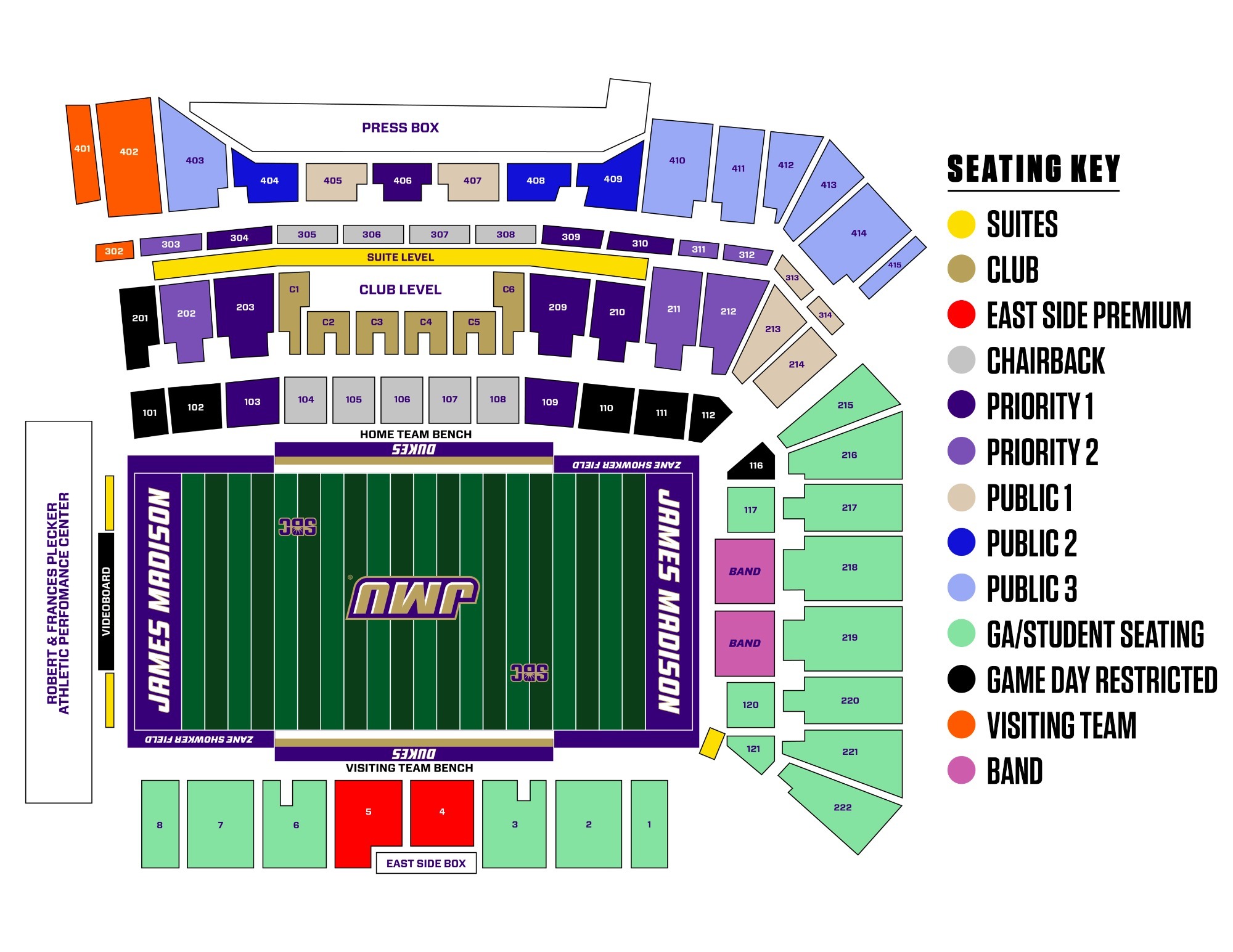
The university's pursuit of the Madison District project, which includes potential impact on Bridgeforth Stadium, was well underway prior to the opportunity emerging with the American Conference. The move does, however, enhance the potential success of the project, and the overlap in timing of the initiatives serves as proof of the staunch commitment to elevate the university as we aim higher for our future.
How will this impact the overall Athletics budget?
Many spending expectations are similar with the move from the Sun Belt to the American. Any growth in the Athletics budget relates less to a conference switch and more to department initiatives, such as improving facilities, growing the student-athlete enhancement and scholarship budgets, filling strategic personnel needs, investing in our technology infrastructure and more. Many of these spending initiatives are guided by the Athletics Strategic Plan, which should be finalized by the end of 2026. The university is committed to providing the resources for JMU Athletics to excel in the American.
How much will JMU receive in conference revenue distributions in the American?
The membership agreement includes a structured integration period that supports JMU's transition into the conference while protecting the value of the existing membership. JMU also participates in certain performance-based and institution-specific revenue opportunities during that period. The agreement establishes a defined path to equal revenue participation. The structure protects current-member media distributions and brings meaningful financial and commercial commitments into the conference. The American evaluated both the immediate economics and the long-term value of the addition before approving JMU's membership.